genetic.algo.optimizeR
Genetic Algorithm Optimization
Genetic algorithm are a class of optimization algorithms inspired by the process of natural selection and genetics. This package is for learning purposes and allows users to optimize various functions or parameters by mimicking biological evolution processes such as selection, crossover, and mutation. Ideal for tasks like machine learning parameter tuning, mathematical function optimization, and solving an optimization problem that involves finding the best solution in a discrete space.
README
<!-- README.md is generated from README.Rmd. Please edit that file -->
# {genetic.algo.optimizeR} <a href="https://danymukesha.github.io/genetic.algo.optimizeR/"><img src="man/figures/logo.png" alt="genetic.algo.optimizeR website" align="right" height="139"/></a>
<!-- badges: start -->
[](https://github.com/danymukesha/genetic.algo.optimizeR/actions/workflows/R-CMD-check.yaml)
[](https://CRAN.R-project.org/package=genetic.algo.optimizeR)
[](https://mybinder.org/v2/gh/danymukesha/genetic.algo.optimizeR/main)
[](https://lifecycle.r-lib.org/articles/stages.html#stable)
[](https://app.codecov.io/gh/danymukesha/genetic.algo.optimizeR?branch=main)
<!-- badges: end -->
Genetic algorithms (GAs) are metaheuristic optimization techniques
inspired by the principles of natural selection and evolution. They
operate on a population of potential solutions, applying genetic
operators such as selection, crossover, and mutation to evolve better
solutions over successive generations(Whitley 1994).
GAs are particularly useful for optimizing complex, non-linear functions
with multiple local optima, where traditional gradient-based methods may
fail(Holland 1992; Goldberg and Holland 1988).
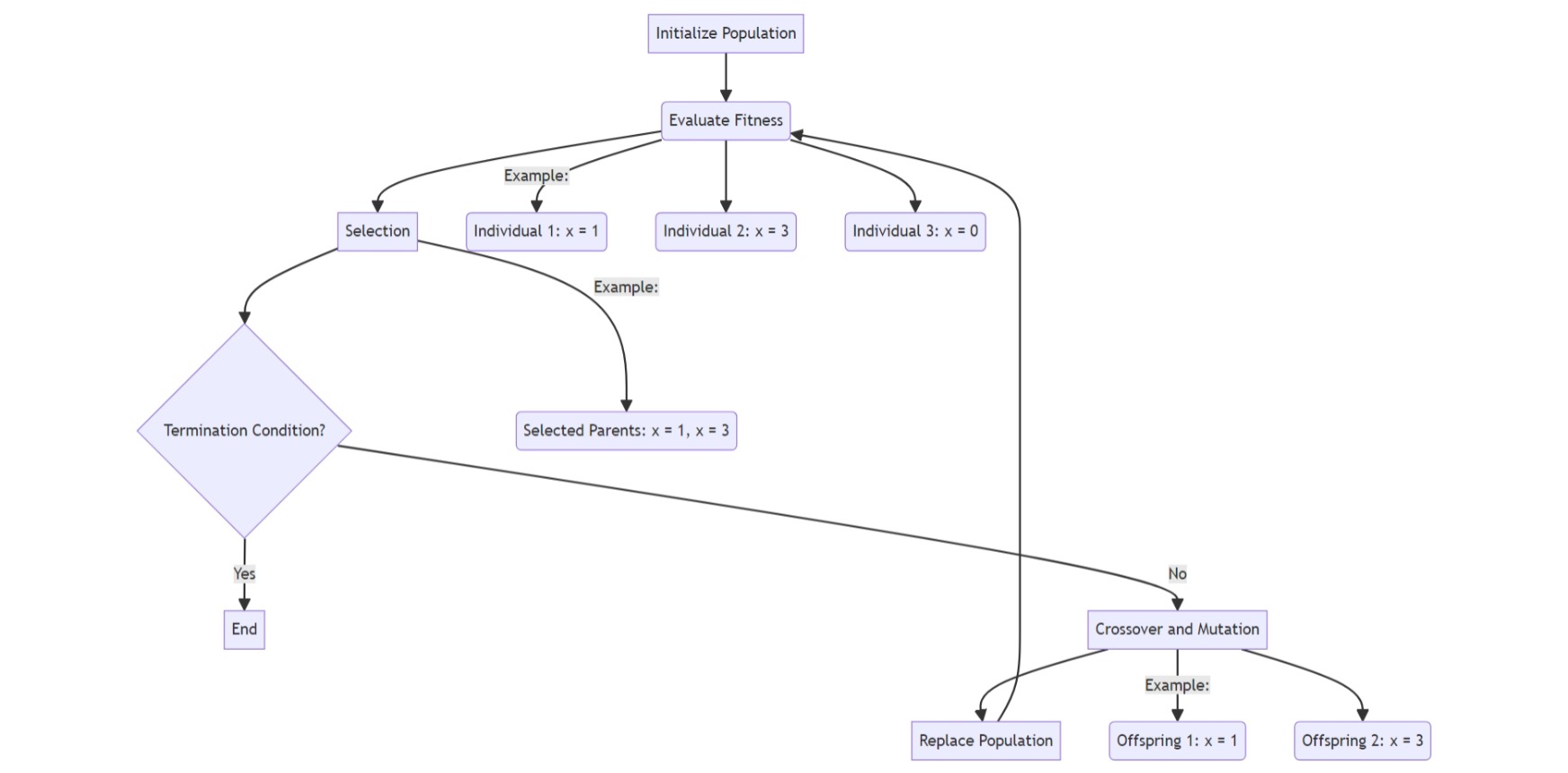
We come out with a simple example to explore how these components work
together in our quadratic function optimization problem using
`genetic.algo.optimizeR` package.
The goal is to optimize the function $f(x) = x^2 - 4x + 4$ using a
genetic algorithm. The function represents a simple quadratic equation,
and the goal is to find the value of $x$ that minimizes the function.
Here’s a breakdown of the aim and the results:
**Aim:**
- Optimize the function $f(x) = x^2 - 4x + 4$ to find the value of $x$
that minimizes the function.
**Results:**
- **Initial Population**:
- We start with a population of three individuals: $x_1 = 1$,
$x_2 = 3$, and $x_3 = 0$. <br>
- **Evaluation**:
- We evaluate the fitness of each individual by calculating $f(x)$ for
each $x$ value:
- $f(1) = 1^2 - 4*1 + 4 = 1$
- $f(3) = 3^2 - 4*3 + 4 = 1$
- $f(0) = 0^2 - 4*0 + 4 = 4$
- **Selection**:
- We select individuals $x_1$ and $x_2$ as parents for crossover
because they have higher fitness.
- **Crossover and Mutation**:
- We perform crossover and mutation on the selected parents to
generate offspring: $x_1' = 1$, $x_2' = 3$.
- **Replacement**:
- We replace individual $x_3$ with offspring $x_1'$, maintaining the
population size.
After multiple generations of repeating these steps, the genetic
algorithm aims to converge towards an optimal or near-optimal solution.
In this example, since it’s simple and the solution space is small, we
could expect the algorithm to converge relatively quickly towards the
optimal solution $x = 2$, where $f(x) = 0$.
[***wikipedia***](https://en.wikipedia.org/wiki/Genetic_algorithm)
## Usage
``` r
library(genetic.algo.optimizeR)
# Initialize population
population <- initialize_population(population_size = 3, min = 0, max = 3)
print("Initial Population:")
#> [1] "Initial Population:"
print(population)
#> [1] 3 0 2
generation <- 0 # Initialize generation/reputation counter
while (TRUE) {
generation <- generation + 1 # Increment generation/reputation count
# Evaluate fitness
fitness <- evaluate_fitness(population)
print("Evaluation:")
print(fitness)
# Check if the fitness of every individual is close to zero
if (all(abs(fitness) <= 0.01)) {
print("Termination Condition Reached: All individuals have fitness close to zero.")
break
}
# Selection
selected_parents <- selection(population, fitness, num_parents = 2)
print("Selection:")
print(selected_parents)
# Crossover and Mutation
offspring <- crossover(selected_parents, offspring_size = 2)
mutated_offspring <- mutation(offspring, mutation_rate = 0) # (no mutation in this example)
print("Crossover and Mutation:")
print(mutated_offspring)
# Replacement
population <- replacement(population, mutated_offspring, num_to_replace = 1)
print("Replacement:")
print(population)
}
#> [1] "Evaluation:"
#> [1] 1 4 0
#> [1] "Selection:"
#> [1] 2 3
#> [1] "Crossover and Mutation:"
#> [1] 2 2
#> [1] "Replacement:"
#> [1] 2 0 2
#> [1] "Evaluation:"
#> [1] 0 4 0
#> [1] "Selection:"
#> [1] 2 2
#> [1] "Crossover and Mutation:"
#> [1] 2 2
#> [1] "Replacement:"
#> [1] 2 2 2
#> [1] "Evaluation:"
#> [1] 0 0 0
#> [1] "Termination Condition Reached: All individuals have fitness close to zero."
print(paste("Total generations/reputations:", generation))
#> [1] "Total generations/reputations: 3"
```
The above example illustrates the process of a genetic algorithm, where
individuals are selected, crossed over, and replaced iteratively to
improve the population towards finding the optimal solution(i.e. fitting
population).
***In theory***
1. Initialize Population:
- Start with a population of individuals: X1(x=1), X2(x=3),
X3(x=0).
(Note: the values are random and the population should be highly
diversified)
- The space of x value is kept integer type and on range from 0 to
3,for simplification.
``` r
population <- c(1, 3, 0)
population
#> [1] 1 3 0
```
2. Evaluate Fitness:
- Calculate fitness(`f(x)`) for each individual:
- X1: f(1) = 1^2 - 4\*1 + 4 = 1
- X2: f(3) = 3^2 - 4\*3 + 4 = 1
- X3: f(0) = 0^2 - 4\*0 + 4 = 4
Coding the function f(x) in R A quadratic function is a function of the
form: ax2+bx+c where a≠0
So for:
$$
f \left(x\right) = x^2 - 4x + 4
$$
In R, we write:
``` r
a <- 1
b <- -4
c <- 4
f <- function(x) {
a * x^2 + b * x + c
}
```
Plotting the quadratic function f(x) First, we have to choose a domain
over which we want to plot f(x).
Let’s try 0 ≤ x ≤ 3:
``` r
# domain over which we want to plot f(x)
x <- seq(from = 0, to = 4, length.out = 100)
# plot f(x)
plot(x, f(x), type = "l") # type = 'l' plots a line instead of points
# plot the x and y axes
abline(v = 0, h = 0, col = "skyblue", lty = 3)
points(c(1, 3), c(f(1), f(3)), col = "coral1", pch = 8, cex = 1.5, lty = 3)
text(c(1, 3), c(f(1), f(3)), labels = c("(x=1, f(x=1))", "(x=3, f(x=3))"), pos = 3)
points(c(0), c(f(0)), col = "blue", pch = 8, cex = 1.5, lty = 3)
text(c(0), c(f(0)), labels = "(x=0, f(x=0))", pos = 4, font = 2)
```
<img src="man/figures/README-initial_poputation-1.png" width="70%" />
3. Selection:
- Select parents for crossover:
- Y1(x=1), Y2(x=3)
``` r
# plot f(x)
plot(x, f(x), type = "l") # type = 'l' plots a line instead of points
# plot the x and y axes
points(c(1, 3), c(f(1), f(3)), col = "coral1", pch = 8, cex = 2, lty = 3)
text(c(1, 3), c(f(1), f(3)), labels = c("(x=1, f(x=1))", "(x=3, f(x=3))"), pos = 3, font = 2)
```
<img src="man/figures/README-selection-1.png" width="70%" />
4. Crossover and Mutation:
- Generate offspring through crossover and mutation:
- Z1(x=1), Z2(x=3) (no mutation in this example)
5. Replacement:
- Replace individuals in the population:
- Replace X3 with Z1, maintaining the population size.
6. Repeat Steps 2-5 for multiple generations until a termination
condition is met.
The optimal/fitting individuals *F* of a quadratic equation, in this
case the lowest point on the graph of f(x), is:
$$
F\left(\frac{-b}{2a}, f\left(\frac{-b}{2a}\right)\right)
$$
``` r
find.fitting <- function(a, b, c) {
x_fitting <- -b / (2 * a)
y_fitting <- f(x_fitting)
c(x_fitting, y_fitting)
}
F <- find.fitting(a, b, c)
```
Adding the Fitting to the plot:
``` r
# plot f(x)
plot(x, f(x), type = "l") # type = 'l' plots a line instead of points
# plot the x and y axes
abline(h = 0)
abline(v = 0)
# add the vertex to the plot
points(
x = F[1], y = F[2],
pch = 18, cex = 2, col = "red"
) # pch controls the form of the point and cex controls its size
# add a label next to the point
text(
x = F[1], y = F[2],
labels = "Fitting", pos = 3, col = "red", font = 10
) # pos = 3 places the text above the point
```
<img src="man/figures/README-fitting_plot-1.png" width="70%" />
***Existing alternative solution***
Finding the x-intercepts of ***f(x)***
The x-intercepts are the solutions of the quadratic equation f(x) = 0;
they can be found by using the quadratic formula:
$$
x = \frac{-b \pm \sqrt{b^2 - 4ac}}{2a}
$$
The quantity $b2–4ac$ is called the discriminant:
- if the discriminant is positive, then *f(x)* has 2 solutions
(i.e. x-intercepts).
- if the discriminant is zero, then *f(x)* has 1 solution (i.e. 1
x-intercept).
- if the discriminant is negative, then *f(x)* has no real solutions
(i.e. does not intersect the x-axis).
<img src="man/figures/README-intercepts.png" width="70%"/>
``` r
# find the x-intercepts of f(x)
find.roots <- function(a, b, c) {
discriminant <- b^2 - 4 * a * c
if (discriminant > 0) {
c((-b - sqrt(discriminant)) / (2 * a), (-b + sqrt(discriminant)) / (2 * a))
} else if (discriminant == 0) {
-b / (2 * a)
} else {
NaN
}
}
solutions <- find.roots(a, b, c)
```
Adding the x-intercepts to the plot:
``` r
# plot f(x)
plot(x, f(x), type = "l") # type = 'l' plots a line instead of points
# plot the x and y axes
abline(h = 0)
abline(v = 0)
# add the x-intercepts to the plot
points(
x = solutions, y = rep(0, length(solutions)), # x and y coordinates of the x-intercepts
pch = 18, cex = 2, col = "red"
)
text(
x = solutions, y = rep(0, length(solutions)),
labels = rep("Fitting(x-intercept)", length(solutions)),
pos = 3, col = "red", font = 10
)
```
<img src="man/figures/README-plot_intercepts-1.png" width="70%" />
We has demonstrated the application of genetic algorithm concepts to
optimize a quadratic function. We’ve explored population initialization,
fitness evaluation, selection, and visualization of results. We’ve also
delved into the theoretical aspects of quadratic functions, including
finding the optimal solution and x-intercepts.
Future developments could include:
- Implementing more sophisticated crossover and mutation operators
- Exploring multi-objective optimization problems
- Applying GAs to more complex, higher-dimensional functions
- Investigating hybrid algorithms that combine GAs with other
optimization techniques
By understanding these fundamental concepts and their implementation, we
can take advantage of genetic algorithms for a wide range of
optimization problems across various domains.
## Advanced topics
### Multi-objective optimization
While our example focuses on single-objective optimization, genetic
algorithms are particularly powerful for multi-objective problems. In
such cases, the concept of Pareto optimality is used to evaluate
solutions, and techniques like NSGA-II (Non-dominated Sorting Genetic
Algorithm II) can be employed(Deb et al. 2002).
### Adaptive parameter control
The performance of genetic algorithms can be sensitive to parameter
settings (e.g., mutation rate, crossover probability). Adaptive
parameter control techniques adjust these parameters dynamically during
the optimization process, potentially improving convergence and solution
quality.
### Parallel implementation
Genetic algorithms are inherently parallelizable. Implementing parallel
versions of selection, crossover, and mutation operations can
significantly reduce computation time for large-scale optimization
problems.
## Wrap-up
Currently only the fundamental concepts and implementation of genetic
algorithms are used in the `genetic.algo.optimizeR` package. By
following these steps and understanding the underlying principles, users
can apply this powerful optimization technique to a wide range of
problems in fields such as engineering, finance, and bioinformatics.
Future developments of the package may include:
1. Implementation of more advanced selection methods (e.g., tournament
selection)
2. Support for constraint handling in optimization problems
3. Integration with other R optimization packages for hybrid algorithms
I would encourage the users to experiment with different parameter
settings and problem formulations to gain deeper insights into the
behavior and capabilities of genetic algorithms.
## References
<div id="refs" class="references csl-bib-body hanging-indent"
entry-spacing="0">
<div id="ref-deb2002" class="csl-entry">
Deb, K., A. Pratap, S. Agarwal, and T. Meyarivan. 2002. “A Fast and
Elitist Multiobjective Genetic Algorithm: NSGA-II.” *IEEE Transactions
on Evolutionary Computation* 6 (2): 182–97.
<https://doi.org/10.1109/4235.996017>.
</div>
<div id="ref-goldberg1988" class="csl-entry">
Goldberg, David E., and John H. Holland. 1988. *Machine Learning* 3
(2/3): 95–99. <https://doi.org/10.1023/a:1022602019183>.
</div>
<div id="ref-holland1992" class="csl-entry">
Holland, John H. 1992. “Adaptation in Natural and Artificial Systems,”
April. <https://doi.org/10.7551/mitpress/1090.001.0001>.
</div>
<div id="ref-whitley1994" class="csl-entry">
Whitley, Darrell. 1994. “A Genetic Algorithm Tutorial.” *Statistics and
Computing* 4 (2). <https://doi.org/10.1007/bf00175354>.
</div>
</div>
Versions across snapshots
| Version | Repository | File | Size |
|---|---|---|---|
0.3.3 |
rolling linux/jammy R-4.5 | genetic.algo.optimizeR_0.3.3.tar.gz |
671.2 KiB |
0.3.3 |
rolling linux/noble R-4.5 | genetic.algo.optimizeR_0.3.3.tar.gz |
671.2 KiB |
0.3.3 |
rolling source/ R- | genetic.algo.optimizeR_0.3.3.tar.gz |
671.2 KiB |
0.3.3 |
latest linux/jammy R-4.5 | genetic.algo.optimizeR_0.3.3.tar.gz |
671.2 KiB |
0.3.3 |
latest linux/noble R-4.5 | genetic.algo.optimizeR_0.3.3.tar.gz |
671.2 KiB |
0.3.3 |
latest source/ R- | genetic.algo.optimizeR_0.3.3.tar.gz |
671.2 KiB |
0.3.3 |
2026-04-26 source/ R- | genetic.algo.optimizeR_0.3.3.tar.gz |
671.2 KiB |
0.3.3 |
2026-04-23 source/ R- | genetic.algo.optimizeR_0.3.3.tar.gz |
671.2 KiB |
0.3.3 |
2025-04-20 source/ R- | genetic.algo.optimizeR_0.3.3.tar.gz |
671.2 KiB |